Inita
web
•
mobile
AI co-pilot for small business owners
A co-pilot for masters of their craft. It takes on the routine digital work so they can stay focused on what they are actually good at.
Situation
The founder came to me with an idea and nothing else — an AI assistant for small business owners who were not especially comfortable with technology. There was no team, no pitch deck, no logo. Not even a CEO.
Task
Build a coherent product from the ground up: a CMS, a website, an appointment system, social channels, client communication and an ads module, all working as one connected experience rather than seven separate tools.
Action
I built a jobs-to-be-done framework, a customer journey map, then interviewed owners around the world about what their pains are. Proposed a retention loop that would deliver the value to a user.
Result
We shipped the MVP within a year and reached 3,000 monthly active users in the year that followed. Along the way the product grew into a full ecosystem, with its own identity, logo and a set of components that quietly removed a large part of an owner’s daily admin.
The mobile experience is a set of modular components, each one handling a specific part of an owner’s day. They work as a single connected system: add or update a service, and the website updates itself while an Instagram post is drafted to announce it.
Onboarding began as a twelve-step wizard. Not because anyone wanted twelve steps, but because of what the technology could do at the time — we needed those twelve answers to generate content specific enough to be useful.
We got it down to two. That had been the goal from the start: the system should be able to launch on two facts alone — where the business is, and what it does.
This reduction in onboarding steps brought the conversion rate up 60% over twelve months. That figure is company-level — engineering’s work on the AI and marketing’s work on the funnel moved it too. Cutting twelve steps down to two is the part that was mine.
Many questions from the cut stages of onboarding were transferred to the stories. This interactive format is not only for filling in the missing pieces of the user’s profile, but also for solving everyday tasks that require the user’s attention.
Jobs to be done
I built the jobs-to-be-done framework we used to map what owners actually have to do for starting, running and growing a small business.
I went through the full range: finding and renting a space, buying furniture, launching ad campaigns, setting up a WhatsApp bot to follow up after a service.

The perfect loop
Then I modelled how a customer moves through a small business, to find the stage that hurt owners most.
The conclusion was that for the product to show real value it had to help owners close what we called the perfect loop — once a customer has been served, the system should help bring them back.

The Google Ads component
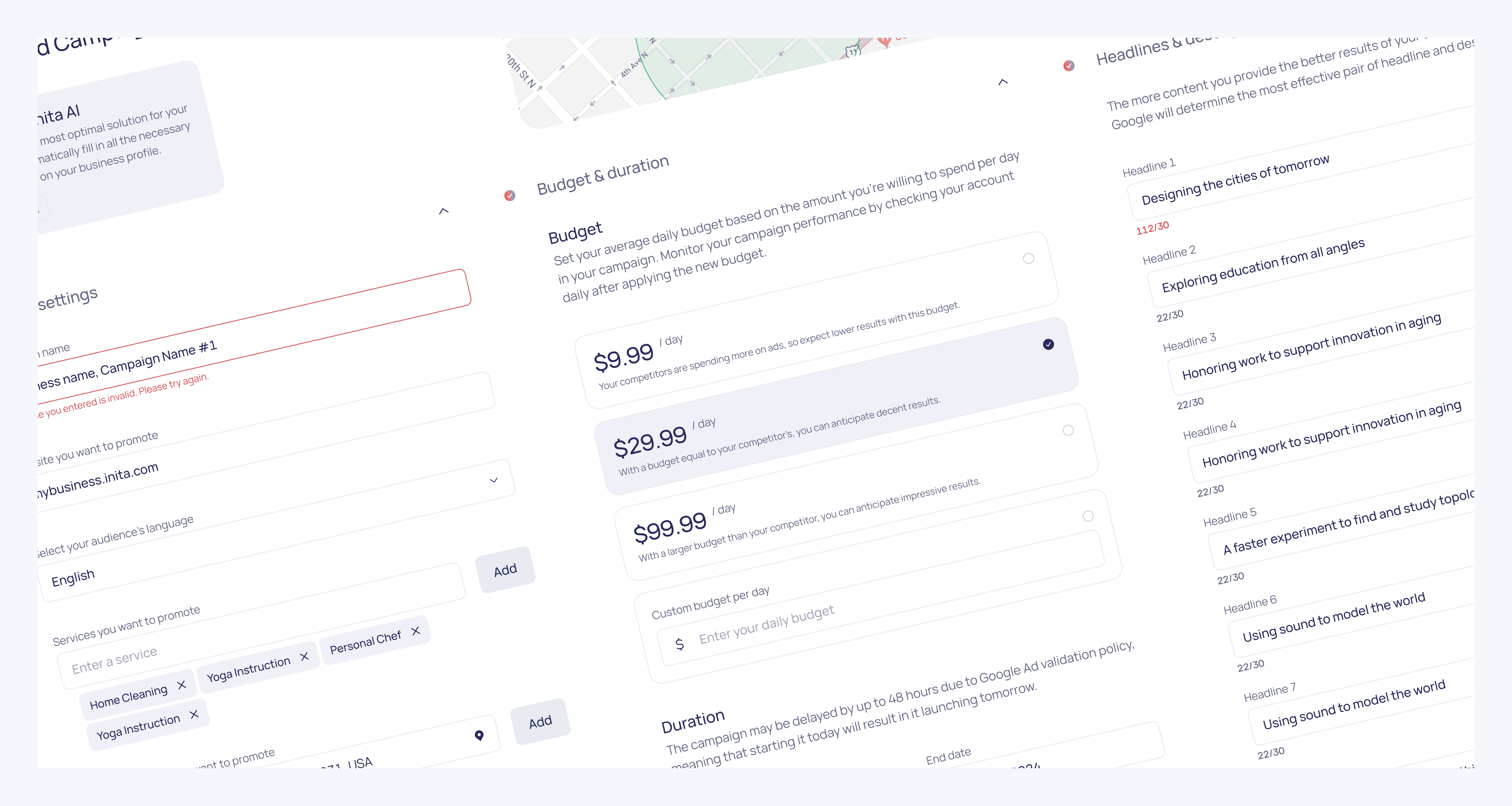
Among others the Google Ads component helped achieve the perfect loop. Its API, though, needs values a person cannot reasonably supply: over 200 parameters, many of them mandatory, and a campaign cannot be submitted half-specified. Every required field had to get a value whether or not the owner had an opinion about it.
So I pushed the asking down as far as it would go — anything the product already knew was pre-filled, anything self-evident was dropped. Campaign setup came out at six questions.

The landing page, which had to carry the whole proposition in a single scroll.
Role
Lead Product Designer
Team
2 designers, 6 engineers
Period
2023 — 2024
Platform
Web, iOS, Android
Next case